The Sunday Reset Checklist for a Calm, Clear Week

A holistic Sunday reset checklist covers four areas: your body, your space, your nervous system, and a brief look at the week ahead — not as a productivity sprint, but as a genuine transition out of the week you just survived.
There's a version of Sunday that exists in your head — slow coffee, clean counters, that specific kind of quiet that makes you feel like you have your life together. And then there's the Sunday that tends to happen, which usually involves catching up on everything you didn't finish last week while already dreading everything that's coming Monday morning.
Key Takeaways
A Sunday reset covers four areas: your body, your space, your nervous system, and a brief look at the week ahead — what it does NOT cover is catching up on everything you didn't finish last week.
Your nervous system needs something sensory before any planning starts — a long shower, slow coffee outside, or ten minutes without your phone are the inputs it uses to register that the week is over.
What restores you on Sunday depends on how you were depleted: mentally fried, physically run down, and emotionally empty all call for different things, and defaulting to "scroll and rest" serves none of them.
Ten to fifteen minutes of light forward intention at the end of Sunday is enough — the goal is to feel informed about your week, not to have it mapped and controlled.
The gap between those two Sundays is real. Most of us treat Sunday like a continuation of the week instead of a transition out of it, and then wonder why Monday morning feels like we never stopped.
A real Sunday reset isn't a productivity sprint (or marathon laundry session) disguised as self-care. It's a genuine shift — something that lands you in the present day, clears the residue of the week behind you, and lets you move into the next one from a place that feels at least a little more grounded than frantic.
That's what this list is built for.
Table of Contents
What Does Your Nervous System Need Before a Sunday Reset?
Before you clean anything or plan anything or prep anything, your nervous system needs to actually register that the week is over. This sounds obvious, and yet most of us skip it entirely. We go from Friday afternoon straight into weekend logistics and family obligations and the mental background noise of everything we didn't finish, and by Sunday night we're already running through the mental to-do list that starts Monday without ever having actually rested.
The sensory stuff matters here — not in a performative, aesthetically pleasing way, but in the genuinely physiological way that your brain needs something to signal that a transition is happening and you need to close the mental clutter of last week.
A long shower (also called the “everything shower”) instead of a quick one.
Coffee made and enjoyed slowly instead of grabbed while you answer emails.
Sitting outside for ten minutes without your phone.
These aren't luxuries. They're the input your nervous system uses to reset, and when you skip them, you stay stuck in the chaos of what did or didn’t happen last week.
This is where the Sunday reset actually starts — not with the list, but with giving yourself a few minutes to land in the day before you do anything else with it.
For me personally, Sunday morning is where I take a much-needed break from being a mom. I get to stay in bed and drink coffee while reading a book for an extra couple of hours, while — and this is KEY — no one bothers me. No making breakfast or running off to a sports event. It hasn’t always been this way (this is much harder with babies and toddlers), but now that I can take this time, it’s been a deeply nourishing nervous system reset routine that makes my whole week feel better.
Why Does Clearing Your Space Help You Reset for the Week?
There is something disproportionately powerful about a clean environment when you're trying to feel like a new week is actually beginning. The pile of mail on the counter, the dishes from Friday night, the three half-empty coffee cups that migrated to your desk — none of it is a big deal on its own, but collectively it sends a signal that nothing has been resolved, nothing has shifted, you're still living inside last week. Those are all open loops on a mental clutter list that gets heavier and heavier until it causes anxiety.
The physical reset doesn't need to be a deep clean. It's not about spending four hours scrubbing baseboards — it's about clearing the visual noise that keeps your brain stuck in catch-up mode. A quick pass through the main living spaces, your desk, whatever surfaces tend to accumulate the chaos of the week. Enough that when you walk through your home on Sunday evening, it feels like a fresh page instead of the same page with more notes crammed in the margins.
This is an act of self-respect more than it is an act of organization. You're setting up the environment that you're going to live and work in for the next five days, and you deserve to start that in a space that doesn't feel like a to-do list you never finished. That feeling of “always behind” is what we want to solve here.
What Should a Sunday Reset Checklist Include?
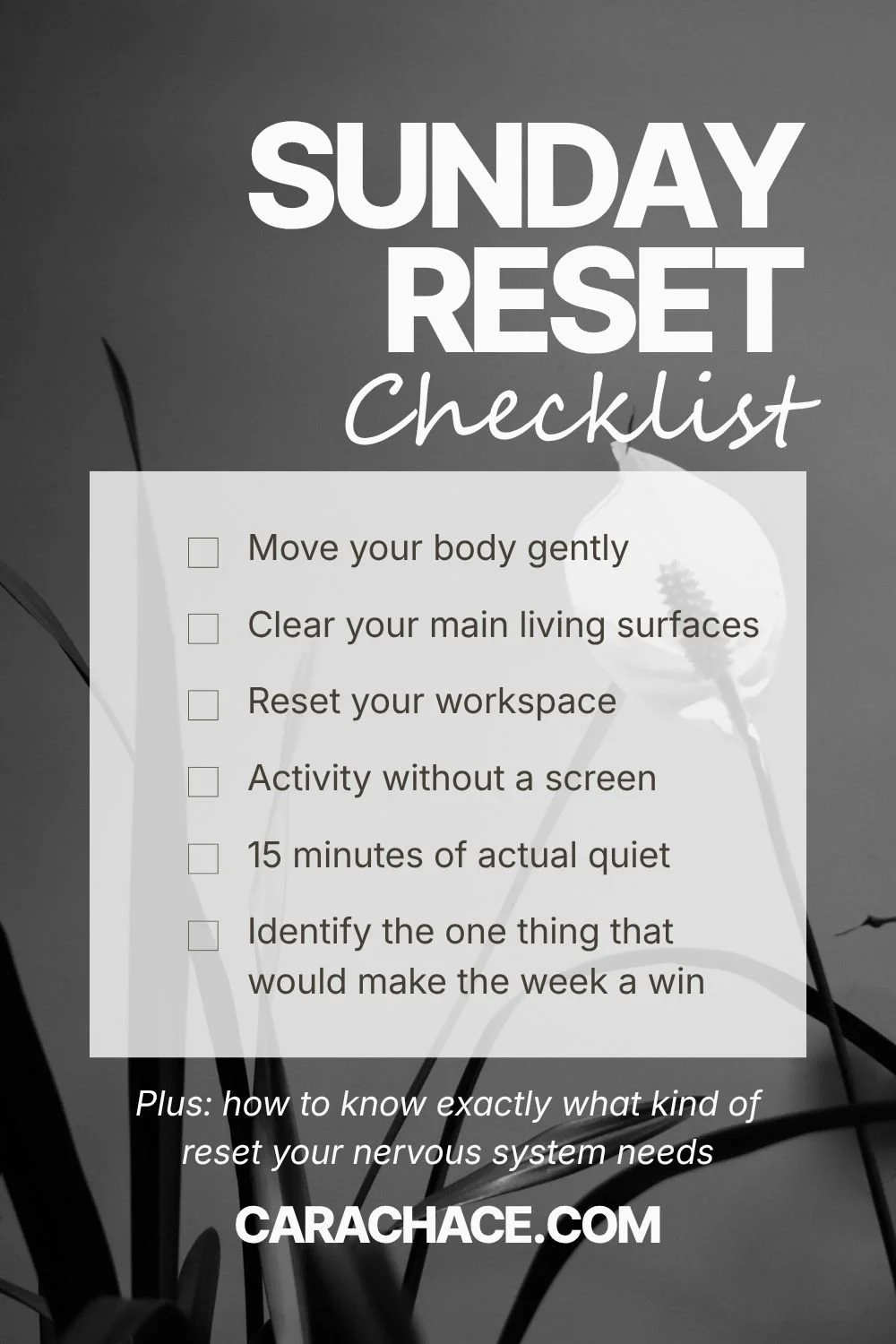
This is the part you can actually save and come back to — not as a rigid checklist to complete in order, but as a menu to choose from based on what kind of week you had and what kind of reset you actually need.
For your body:
Move it gently — a walk, a stretch, something that's about feeling good rather than burning calories or hitting a goal
Eat something real and intentional mindfully, not just whatever's fast
Get outside, even briefly, even if it's cold
Go to bed at an actual reasonable hour (this one counts as Sunday prep)
For your space:
Clear your main living surfaces — counters, table, the couch that's been a staging area for laundry all week
Reset your workspace so Monday morning doesn't start with Sunday's mess
Do the one nagging household thing that's been living in the back of your mind (you know the one)
For your nervous system:
Something without a screen — a book, a bath, a real conversation, a coffee date with a friend, music you actually listen to instead of use as background noise
Fifteen minutes of actual quiet, not just quiet-while-doing-things
Whatever specifically makes your particular brain feel less like a browser with forty tabs open
For your week ahead:
A quick look at what's actually coming — not a full planning session, just enough to stop Monday from ambushing you
Identify the one thing that would make the week feel like a win if it got done
Note anything that needs to be handled first thing so it's not sitting in your brain all Sunday night
That last section is where the reset crosses from self-care into intention, and it doesn't need to take more than ten or fifteen minutes. The goal is to feel informed about your week, not to have it perfectly mapped — there's a difference between knowing what's coming and trying to control all of it, and Sunday should only ever ask you to do the first one.
(If you want a more structured approach to the planning piece, the Friday Reset post is built specifically for closing out your week — these two work well together.)
What Kind of Sunday Rest Does Your Tired Brain and Body Need?
Not every self-care list translates to an actual busy woman's Sunday, partly because "self-care" has become so loaded with expectation that it creates its own pressure, and partly because what genuinely restores you depends on what specifically depleted you this week.
If you're mentally fried — if you spent the week in your head, making decisions, solving problems, managing other people's needs — what you probably need is something that doesn't ask anything of your brain. A walk without a podcast. Cooking something with your hands. Sitting outside and watching something that moves, birds or clouds or traffic, without trying to think anything useful about it.
If you're physically worn out — if your body has been running hard, if you haven't slept well, if you've been going nonstop — what you probably need is permission to actually stop. Not productive rest, not "recovering so you can do more," just rest that doesn't justify itself. And by the way, scrolling social media while laying on the couch is not rest.
If you're emotionally depleted — if the week involved a lot of giving, a lot of managing, a lot of being what other people needed you to be — what you probably need is either genuine connection with someone who fills your tank, or genuine solitude where nobody needs anything from you (like my Sunday morning in bed routine). Read the signals honestly, because sometimes we reach for connection out of habit when what we actually need is to be alone, and sometimes we isolate when what would actually help is a real conversation.
The common thread is that real restoration requires you to actually notice what you need instead of defaulting to whatever self-care looks like on Sunday in theory.
Your Sunday reset works when it's responsive to what you specifically need that week, not performing recovery at yourself.
What Does a Good Sunday Reset Do for Your Week Ahead?
The point of all of this isn't a perfect Sunday. It's Monday morning feeling like you have space to start the week mindfully, and less like a collision — the difference between walking into your week and being run over by it.
When Sunday has a reset built into it, a real one that includes both the physical clearing and the actual rest and the brief forward intention, Monday stops being something that happens to you. You know what's coming. Your space reflects a fresh start. Your body has had at least some of what it needed. That's not a small thing, especially when you're running a business and managing a life and trying to do both without completely losing yourself in the process.
You don't have to nail every item on the list every week. Some Sundays are full of other obligations and you get twenty minutes of intentional reset and that has to be enough. But when you have the day, or even a few hours of it, this is what's worth spending it on.
Ready to make a real change in your routines?
Like building a planning system that makes your Sunday intentions stick through the week? Chaos Detox is the weekly planning method that bridges the Sunday reset and the rest of your week — under 60 minutes, built for real life, and flexible enough to hold even when Tuesday falls apart.

What If You Need More Than a Sunday Reset?
If what you're experiencing goes deeper than a Sunday reset can touch — the kind of exhaustion that's been building for months, the burnout that a good morning routine isn't going to fix — that's what working with me as your coach is for.
Our work together sits at the intersection of burnout, boundaries, marketing, systems, and simplification—because those things aren’t really separate, and treating them like they are is exactly how women end up exhausted and wondering why working harder isn’t working.
Frequently Asked Questions
-
A good Sunday reset checklist covers four areas: your body, your space, your nervous system, and a light look at the week ahead. The goal isn't to complete a rigid list — it's to clear the residue of last week and ease into the next one feeling grounded rather than already behind. Start with something sensory to signal the transition, move through your physical space, give yourself genuine rest in whatever form restores you, and end with ten minutes of forward intention.
-
It depends on what you have available, and honestly, even twenty minutes of intentional reset is better than none. If you have a few hours, use them — move through the physical reset, take time for real rest, and do a light planning check-in at the end. If Sunday is packed, prioritize the nervous system piece first and the planning piece second, and let the rest wait for a better week.
-
A Sunday reset supports burnout prevention by building a consistent transition between weeks — one that includes actual rest, not just productivity prep. It won't fix chronic burnout on its own, but it does interrupt the cycle of running from one week straight into the next without ever stopping to restore. If what you're experiencing goes deeper than a weekly routine can touch, burnout coaching may be the right next step.
-
A Sunday reset is about self-care and transition — clearing your space, restoring your nervous system, and easing into the week from a calm starting point. A weekly reset is more planning-focused: closing out what didn't happen, deciding what next week holds, and setting up your structure. They work well together. The Sunday reset is the restorative piece; the weekly planning reset is the operational one.
Related Posts:
Weekly Reset Done Right: Why Friday Beats Sunday Every Time
When Do You Work? 3 Ways to Map Your Energy to Boost Productivity
How To Unplug: A Simple Guide for Online Entrepreneurs
Liked this post? Pin it to Pinterest!