
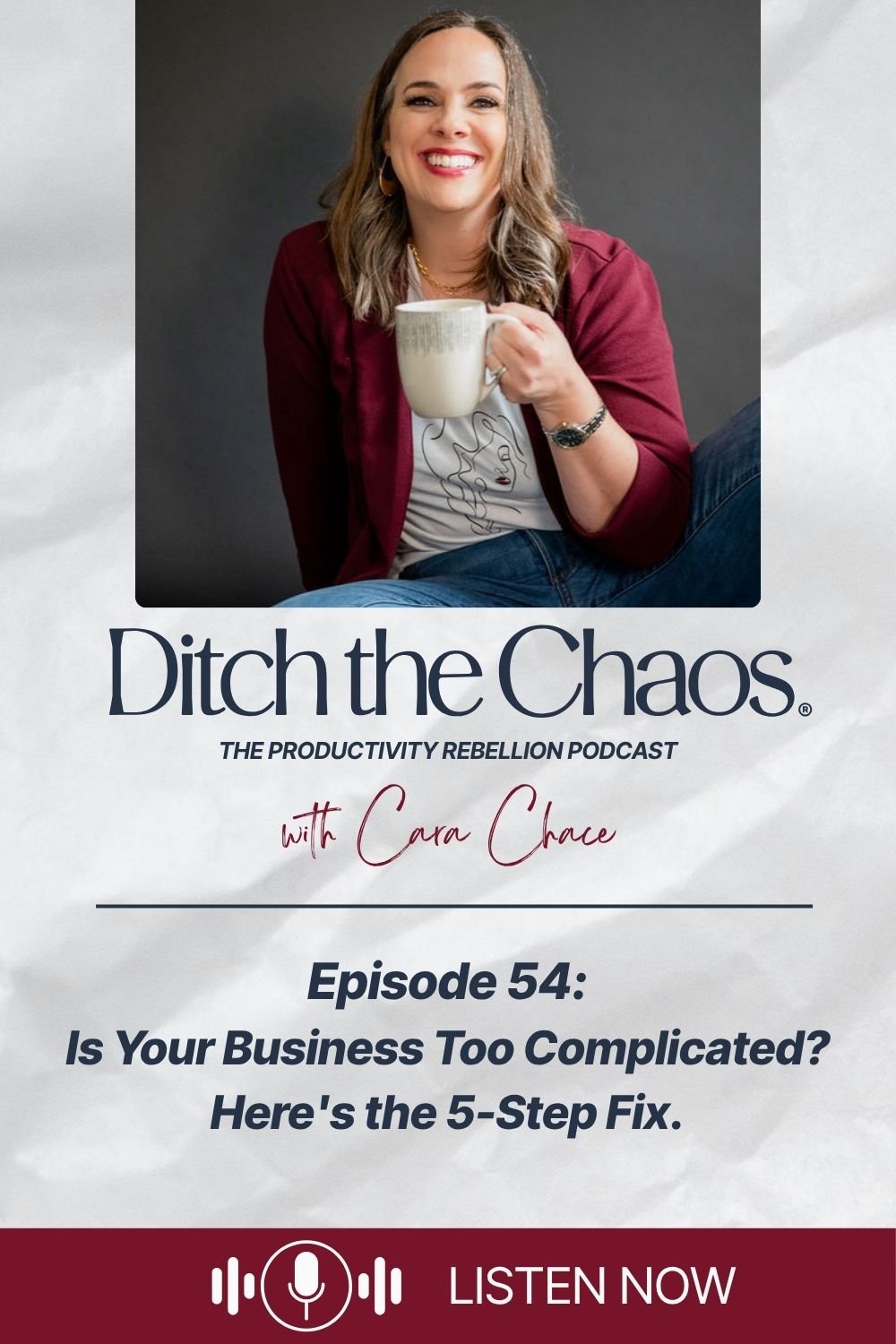
Is Your Business Too Complicated? Here's the 5-Step Fix.
At some point — whether you're brand new to business or you've been at this for years — it's easy to wake up and realize you've built something more complicated than it needs to be. Software subscriptions you barely use, offers tied to platforms that need constant updating, funnels that made perfect sense at the time but now feel like a tangled mess. And somewhere in the middle of it all, you're paying hundreds of dollars a month just to keep the thing running.
This episode is Cara's honest walkthrough of how she stripped her own business down to what worked — not because it sounded like a good strategy, but because a health crisis made it necessary. The result was a simpler, more intentional business that actually fit her life.
These lessons come straight from what Cara teaches inside Chaos Detox — because building a business that works for your real life right now, not some future version of it, is exactly the kind of thinking that changes everything.
In this episode, you'll learn:
Why most women entrepreneurs accidentally build businesses for where they want to be, not where they are
How to evaluate your offers and cut what's draining you without second-guessing everything
A two-question framework for every tool and subscription on your list (00:05:10)
Why branding tweaks are one of the sneakiest forms of avoidance
What to do before switching email platforms so you don't start over from scratch (00:10:00)
How to use 12-week planning to actually complete a big simplification project (00:11:35)
The ongoing mindset habit that makes all of this stick (00:13:03)
All Resources Mentioned in This Episode:
The Productivity Rebellion (free monthly guide): carachace.com/productivity-rebellion
Chaos Detox: carachace.com/chaos-detox
Focus Sessions (co-working community): https://carachace.com/focus-sessions
Magic Marketing App (AI marketing app): https://carachace.com/marketing-magic
Thrivecart (lifetime pricing shopping cart + course platform): https://carachace.com/thrivecart
Notion (free project management): https://carachace.com/notion
Flodesk (email marketing): https://flodesk.com/c/TI8D7Z
The 12-Week Year (book): https://amzn.to/3QccJQm
Affiliate links may be present, so I may earn commissions on products I love, at no cost to you. Your support fuels my coffee habit while I share my favorite stuff—win-win!
Need more help?
Build your personal, unique productivity system without burnout or pressure. Choose what fits:
Join The Productivity Rebellion (free monthly guide): Get productivity strategies for busy lives, and real talk for women who refuse to choose between success and sanity. Plus, submit your questions and I'll answer them on the show. Sign up here →
Start Chaos Detox: The repeatable weekly planning method for women entrepreneurs dealing with burnout. Learn more →
Work with me 1:1: Get clear, personal guidance to simplify your strategy and follow through on what actually works. Coaching options →
Want to read the original blog post that inspired this episode?
CLICK HERE → Creating a Simple Online Business: How To Go From Complex to Clear
Are you loving this?
Hit follow on your favorite podcast app so you never miss an episode. You can listen and subscribe right here:
Full Episode Transcript
Is Your Business Too Complicated? Here's the 5-Step Fix.
[00:00:00] You built a business to have freedom, so why does running it feel like you're managing a small corporation with a full-time IT department and a bunch of interns? Welcome to Ditch the Chaos. I'm Cara Chace, and this is your space to figure out how to run your life and business without running yourself into the ground.
[00:00:19] Today. I am talking about something I've lived through personally. What it actually looks like to strip your business down to what works, cut what doesn't, and stop paying for tools you don't need. Because simpler is not a step backward.
[00:00:32] Sometimes it's the smartest move you can make. Let's get to it.
[00:00:37] I wanna start with something that might feel a little awkward to admit out loud at some point. Whether you're brand new to business or you've been at this for years, you might wake up and realize you've built an over complicated mess.
[00:00:51] You've got a stack of software subscriptions, offers that all connect to different platforms, funnels that made sense when you set them up, but now feel like a bowl [00:01:00] of spaghetti and somewhere in the middle of all that you're paying hundreds of dollars a month to keep it all running. I know this because I've been there, and here's what I kept doing without realizing it.
[00:01:11] I was making decisions about tools, about money, about offers based on where I wanted to be in my business. Not where I actually was. Let me give you a really clear example of what that looks like.
[00:01:25] Say you're building your email list and you're at a few thousand subscribers, you start hearing advice from people with 50,000 subscribers. Tag your audience, build out complex automations, segment everyone based on exactly where they're at in your customer journey. And honestly, that sounds amazing and super high level.
[00:01:45] So you invest in the tool that makes that possible, or you spend countless hours building it all out. But if you don't have 50,000 subscribers yet, what your audience of a few thousand really needs is just to know what you offer and hear from you [00:02:00] consistently. You don't need to pay for features you're not using to solve problems you don't have.
[00:02:06] Now, I do wanna be clear, there are times when investing above your current level makes sense, like joining a mastermind to be around people at the next level of business that can absolutely pay off. But the day-to-day gears of how you run your business, those need to match where your business is right now.
[00:02:24] I knew that my own backend system was a cobbled mess for a few years, but I was finally forced to deal with it when my health forced me to take a step back for my business a couple of years ago. After finding out that I was dealing with mold toxicity, Lyme disease, and some major gut issues, I knew I needed to pause on my offers and my clients to focus on healing.
[00:02:46] And because I was also stepping back from most of my income, I had to take a hard look at every dollar that was going out the door. I needed to simplify everything fast. Everything I mentioned today that you might [00:03:00] wanna check out is mentioned in the podcast description and in the show note. What I found out when I actually sat down and looked at everything really surprised me.
[00:03:08] So that's what today is about. The five things I did to go from over complicated and draining to simple and evergreen and how you can apply this thinking to your own business, whether you're in a season of scaling back or just tired of the chaos you've accidentally built without realizing it.
[00:03:25] Okay, step one, evaluate what's working and what isn't. The first thing I did was take a clear-eyed look at what needed to stay and what needed to go in my business.
[00:03:37] I started with my offers and products. I had several products that were tied to specific platforms, namely Pinterest and Clickup, and they would've required ongoing updates to stay current and useful. So those had to come down. They weren't serving people the way they should and maintaining them wasn't something I had the bandwidth or the energy for.
[00:03:57] Then I looked at my newsletter. [00:04:00] I had been running what's often called a newsletter as a product funnel. It was a big strategy that was super hot, and it's been getting a lot of attention over the last few years. I was spending hours weekly putting it together for my list,
[00:04:13] but I looked at my actual results to ask myself was it generating enough income through sponsors or affiliates to justify the time, effort, and cost of the email service provider I was using. The answer was it wasn't even close, so I made a big shift with that, which I'll get to in a minute. I also had to be honest about my one-to-one coaching and team consulting.
[00:04:36] Because of my health struggles, I just didn't have the energy for it. So I put those offers on a wait list status, and gave myself permission to figure out later what I'd be willing to take on and when I could. And then I did something that I think gets overlooked a lot.
[00:04:51] I identified a handful of key partners like Focus Sessions and Magic Marketing app, and decided to refer my audience to them for [00:05:00] core areas I knew my people cared about. Instead of trying to be everything I could point people towards things I genuinely trusted. The question to ask yourself here is simple.
[00:05:10] If I had to cut my business in half tomorrow, what would I absolutely keep doing and everything else that's worth questioning. Okay. On to step two, sourcing evergreen tools. Once I knew what I was keeping, I went through every single software subscription tool and app that I was paying for. I already had a spreadsheet tracking all my business expenses, what they cost when they charged yearly versus monthly.
[00:05:36] And if you don't have something like that set up yet, I highly recommend you go do that immediately. Set aside a few hours, pull up your bank statements and credit card bills and build it out. You will be surprised by what you find and it'll probably make all these decisions easier. My criteria for evaluating everything was super straightforward.
[00:05:56] Do I need this? And if I do, can I [00:06:00] find something similar for less? The best tools for this particular situation, meaning I was stepping back from a lot of my income, was finding free or close to free tools. Or tools that you pay for once and then you have lifetime access instead of a recurring subscription.
[00:06:17] And here's what that looked like for me. I switched from clickup, which was an expensive project management system to Notion, which is free for all project management.
[00:06:27] I moved my email service provider from Kit to Squarespace email, and I'll talk about that more in a minute. I also eliminated my Adobe subscription, my video hosting all my social media scheduling apps except for Tailwind, and I finally said goodbye to Zapier.
[00:06:45] The main tool that I kept and have to mention is Thrive Cart. It's my all-in-one e-commerce shopping cart and course platform. And the reason I stayed is it's lifetime pricing. There's no monthly subscription. You pay [00:07:00] once for a business trying to simplify and cut recurring costs. That's pretty hard to beat.
[00:07:04] The goal of this step isn't to go minimal for the sake of it. It's to make sure every dollar you're spending is actually earning its place in your business right now, not in some future version of your business that doesn't exist yet. Okay. On the step three simple branding, I have to be honest about this one because it's a little embarrassing and it's kind of a thing that I've always struggled with.
[00:07:29] I cannot resist a beautiful font or a gorgeous color palette. And my branding history over the years is proof of that. When I sat down to think about what I wanted my evergreen brand to look and feel like, I kept coming back to three words, calming and luxurious with an edge, calming, luxurious edge. That was it.
[00:07:51] That was the whole design brief. I decided to use a serif font for the first time ever in my headlines. I simplified my color palette [00:08:00] down to variations of deep blue with a lot of neutrals. One thing that actually helped was that I went to chat GPT and asked what color palette would attract my ideal audience, professional woman who want to live more intentionally, and it gave me a really useful starting point that I could then go refine on my own.
[00:08:20] The lesson here isn't about fonts and colors specifically. It's about making a decision and stopping the cycle of tweaking Constantly. Updating your branding is one of the sneakiest forms of busy work. It feels productive and creative, but it usually just means you're avoiding something you really need to do.
[00:08:39] So pick your direction with your branding. Make it simple so you don't have to constantly decide and then stop touching it. When I knew I was healthy enough to relaunch my business, I then paid for professional branding so I could just know for sure that it was on point, and then I would love it. Okay, onto step four, [00:09:00] email marketing in the Big switch.
[00:09:03] This is the section I wanna slow down on because it involves a decision I never thought I'd make Again. I switched email service providers and before I explain why I wanna say this clearly. Kit, which was formally known as Convert Kit. Is genuinely one of the best email platforms out there for creators and online entrepreneurs.
[00:09:24] The tools are thoughtful. You get a lot for your money, and there was nothing wrong with it. It just had way more capability than I actually needed, and I was paying for all of that. So when I decided to pause my business, I move to Squarespace email. It's significantly more affordable and it has the core features.
[00:09:44] I needed sequences and automations, and it integrates directly with my website since I'm already on Squarespace. So it really made sense for where my business was before I made the switch. I did two things that I'd highly recommend anyone thinking about [00:10:00] changing platforms do. First, I ran a cold subscriber sequence.
[00:10:05] I wanted to identify anyone who had stopped engaging with my content so I could give them a chance to stay or let them go. Cleaning your list before a migration means you're not dragging dead weight into a new system or paying for them to be on your list. Second, I downloaded every tagged segment of my list.
[00:10:24] Even if I wasn't going to use all that data right away, I wanted to just have it for reference. You never know when you might need to remember who was who and why they were on your list. Then I set up a simple, calm, welcome sequence for new subscribers, and I shifted from sending a weekly email to sending one a month.
[00:10:44] My updates on life, business and living more purposefully. It felt so much better and I got a lot of feedback from readers saying it was soothing and lovely to receive, which was exactly what I was going for. Now that my business [00:11:00] requires a bit more than Squarespace email can provide. I moved over to Flodesk.
[00:11:05] There are unlimited subscribers, and sends for one low monthly price. Was hard to beat. And since I first moved off of Kit, their monthly price, that went way up. And again, if I was using all the features they offer, I would've consider it, but that's not what my business needs right now. So I needed to not pay for it.
[00:11:24] These are the kinds of decisions and shifts that I help you with inside chaos, detox, cutting. What's draining you and designing something that fits your life and your business right now.
[00:11:35] Okay, onto step five, 12 week year planning.
[00:11:39] The last piece was figuring out how to actually get all of this done, meaning the downshift in my business and simplifying all my systems without it becoming another overwhelming project I'd never finish. I went outside and sat on our deck on one of the last warm days of summer with a notebook, and I wrote down everything.
[00:11:58] I mean, everything that [00:12:00] needed to happen for my business to be considered done and hands off so I could focus on my health. That list included small things like make sure all my social media profile pictures match and big multi-week projects like update all my blogs. Once I had the full picture, I turned to the 12 week year to map it all out.
[00:12:20] If you're not familiar with this, it's a planning method that uses 12 week cycles or 90 days instead of annual goals. The idea being that a shorter horizon creates more focus and urgency without the overwhelm of the year long to-do list. I broke the whole project into sections and timelines, mapped it into my calendar, and gave myself a target.
[00:12:42] If I stayed on track, my business would be fully evergreen and updated by the first week of December. Just thinking about crossing that finish line made me take a deep, satisfied breath. And here's what I love most about this step. Once it's done, anything you choose to [00:13:00] do with your business after that is a choice.
[00:13:03] It's not an obligation. It's not a have to. It's a considered intentional choice. That's what planning at this level buys you. Not just a finished project, but freedom, breathing room and white space on the other side of it. So how do you embrace this kind of simplicity as a mindset in your business? This is a piece that I wanna add, and it wasn't on the original five step list because I think it's actually the part that makes all of this stick together.
[00:13:31] When I moved to Squarespace for email, I ran into some limitations pretty quickly. It restricts how many emails you can send per month, and it doesn't integrate easily. With most third party tools without Zapier, which was a subscription that I had just canceled, my first instinct was to panic. I started thinking that I needed to upgrade, sign back up to Zapier, reconfigure my whole email marketing evergreen plan, and then I paused [00:14:00] and I took a breath and I asked myself, why do I actually need to do any of that?
[00:14:05] The answer was I didn't. If my newsletter was only going to go out once a month, that's not a limitation. It forces it to be intentional. It's the best of my thinking from the last few weeks, not just content for the sake of filling an inbox weekly, because other online entrepreneurs say that's what you have to do. If Squarespace doesn't play nicely with fancy third party tools, fine. I can do without it, and it's one less thing to break. This is what embracing simplicity as a mindset looks like in practice. It's not a one-time decision. It's a constant habit of questioning, do I actually need this? Is this adding complexity that serves me, or complexity I'm just used to,
[00:14:49] and then having the discipline to let go of what doesn't make the cut. The essence of it is this, keep questioning, eliminate what's unnecessary, and keep [00:15:00] your focus on what actually matters. So let's bring this all home for you. You don't have to be going through a health crisis or a major life pivot to apply any of this.
[00:15:11] You can do a version of this audit anytime your business starts to feel heavier than it should. When the to-do list grows faster than you can work through it when your expenses are creeping up or when your business tools and upkeep just feel way too complicated. I highly recommend doing this over the winter season.
[00:15:28] If you're able to. There's something about that. Slow down and pause energy that's perfect for this kind of project. The five steps I walked you through are evaluate what's working. Look at your tools, simplify your branding. Reassess your email strategy and map out this project with a focused planning method.
[00:15:50] Here's your reset and reclaim action step for the week. Open your bank or credit card statement for your business and pull up every recurring expense you're [00:16:00] paying for right now. Don't cancel anything yet. Just look and write it all down in one place. If you don't already have a spreadsheet going. Then ask yourself two questions for each line item. Number one, do I really need this? And number two, is it priced right for where my business is right now?
[00:16:18] You might be surprised at how much you're paying for. That's about where you want to be instead of where you are. So that's it. Just start there.
[00:16:27] If this resonated, come join the Productivity Rebellion.
[00:16:31] It's my free monthly guide for women who are tired of holding everything together with duct tape and coffee. One email a month, zero overwhelm. It's like tucking into your favorite magazine on Sunday morning. Sign up a carachace.com/productivity-rebellion. And thanks for listening. If this helped, please leave a review.
[00:16:50] It helps other women entrepreneurs find the show. I'm Cara Chace reminding you to keep questioning the rules and making your own. I'll see you next week.


I'm pausing the podcast to launch my book, The Social Media Burnout Cure. Here's what's happening, when I'll be back, and how to stay close in the meantime — including how to get on the launch list for first look at the introduction.